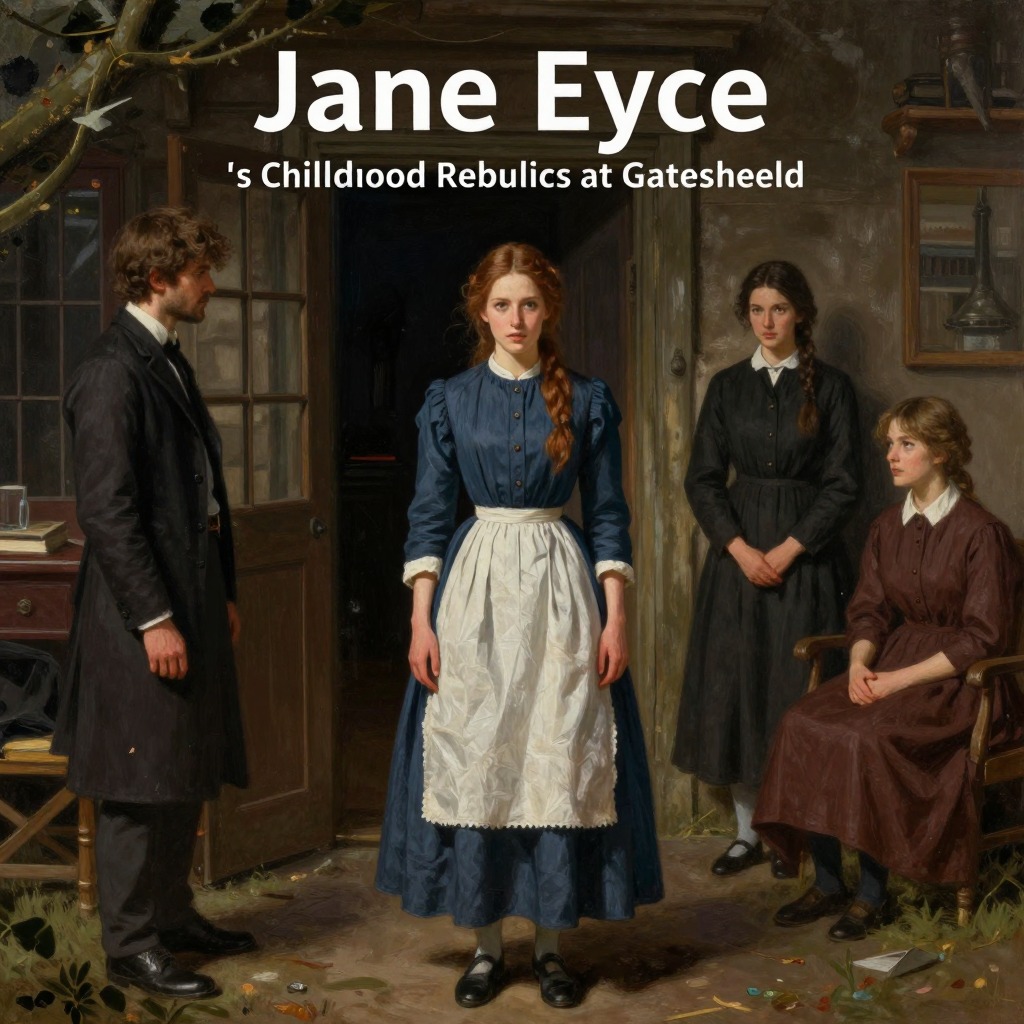
early in the story, a winter afternoon at Gateshead
Jane Bullied by John Reed
Ten-year-old Jane Eyre, an orphan living with her aunt Mrs. Reed at Gateshead Hall, is bullied by her fourteen-year-old cousin John Reed. He finds her reading behind a curtain, strikes her, and throws a book at her, causing a head wound. Jane fights back, calling him a murderer and a slave-driver. The servants Bessie and Miss Abbot separate them, and Mrs. Reed orders Jane locked in the red-room as punishment. This event establishes Jane's position as an unwanted dependent and her passionate, rebellious nature.
later the same day at Gateshead
Imprisonment in the Red-Room
Jane is forcibly taken to the red-room, the chamber where Mr. Reed died nine years earlier. She is locked in alone, without a candle, as the room grows dark. Terrified by the gloomy atmosphere and her own superstitious fears, she imagines seeing Mr. Reed's ghost. She screams and begs to be released, but Mrs. Reed refuses and locks her in again. Jane suffers a fit and loses consciousness. This traumatic event deepens her sense of injustice and isolation, and it leads to her first serious illness at Gateshead.
the next day at Gateshead
Mr. Lloyd Visits Jane
After her fit, Jane wakes in the nursery to find the apothecary Mr. Lloyd attending her. He is kind and gentle, and Jane confides in him about her unhappiness at Gateshead. She tells him about the red-room incident and her mistreatment by the Reeds. Mr. Lloyd suggests to Mrs. Reed that Jane might benefit from going to school. This conversation plants the first seed of hope for escape in Jane's mind and sets in motion the plan to send her away from Gateshead.
a few months later, in January at Gateshead
Jane Confronts Mrs. Reed
After months of cold treatment and isolation, Jane learns that Mr. Brocklehurst, the director of Lowood School, is coming to interview her. Mrs. Reed warns him that Jane is deceitful. After he leaves, Jane, overwhelmed by rage and a sense of injustice, confronts her aunt. She declares she does not love Mrs. Reed and that she is not deceitful. She accuses her aunt of cruelty and says she will tell everyone at Lowood the truth. This outburst marks Jane's first open rebellion and a significant step in her emotional development.
January 19th, early morning at Gateshead
Jane Leaves Gateshead for Lowood
Jane departs Gateshead Hall by coach at six in the morning. She says a brief, cold farewell to Mrs. Reed and a more affectionate one to Bessie. The journey is long and lonely, but Jane feels a sense of relief and anticipation. She arrives at Lowood Institution late at night, tired and bewildered. This event marks the end of her childhood at Gateshead and the beginning of her education and new life at Lowood.
the day after her arrival at Lowood
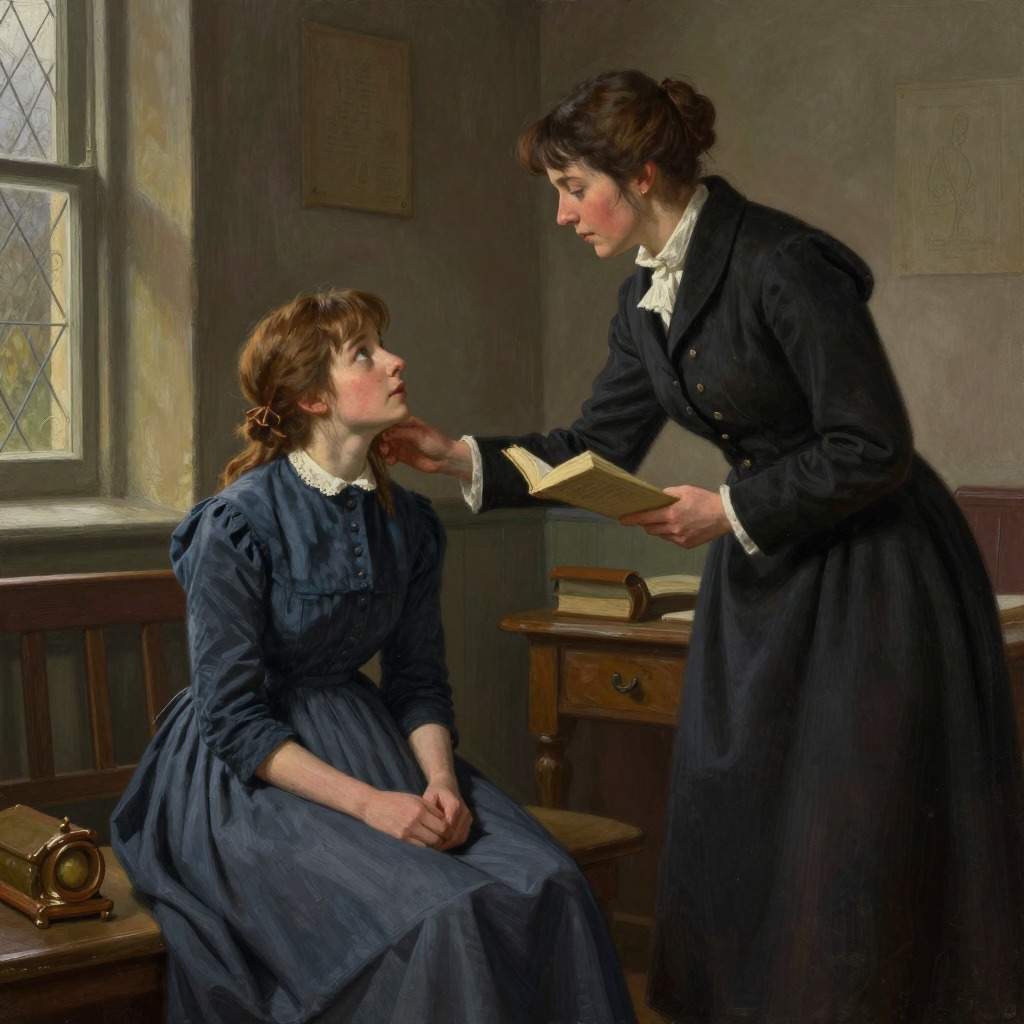
Jane's First Day at Lowood
Jane experiences the harsh realities of Lowood: burnt porridge for breakfast, cold and sparse dormitories, and strict discipline. She meets Miss Temple, the kind superintendent, and the other teachers. She also encounters the cruel Miss Scatcherd. During a walk in the garden, she meets Helen Burns, an older girl who is reading Rasselas. Helen explains the charitable nature of the school and answers Jane's questions. This day introduces Jane to the two key figures who will shape her time at Lowood: the benevolent Miss Temple and the stoic, intellectual Helen Burns.
later in Jane's first week at Lowood
Helen Burns is Punished
Jane witnesses Miss Scatcherd publicly humiliate and flog Helen Burns for having dirty nails. Helen endures the punishment without crying or showing anger, which astonishes Jane. Later, Jane questions Helen about her passive acceptance of injustice. Helen explains her Christian philosophy of turning the other cheek and forgiving one's enemies. This conversation deeply impresses Jane and introduces a moral and spiritual conflict between her own fiery sense of justice and Helen's doctrine of endurance.
three weeks after Jane's arrival at Lowood
Mr. Brocklehurst Humiliates Jane
Mr. Brocklehurst visits Lowood and, after lecturing the school on austerity, singles out Jane. He forces her to stand on a stool in front of the entire school and denounces her as a liar, based on Mrs. Reed's accusations. He orders the other girls to shun her. Jane is devastated by the public shame, but Helen Burns smiles at her as she passes, giving her strength. This event is a turning point: it tests Jane's resilience and solidifies her bond with Helen.
about a week after the humiliation at Lowood
Miss Temple Clears Jane's Name
Miss Temple, having written to Mr. Lloyd to verify Jane's story, assembles the school and publicly declares Jane innocent of the charges of deceit. Jane is exonerated and accepted by her peers. That evening, Miss Temple invites Jane and Helen to her room for tea and seed-cake, creating a warm and intellectual atmosphere. This event restores Jane's reputation and strengthens her trust in Miss Temple, marking the beginning of her happier and more successful years at Lowood.
spring, during Jane's first year at Lowood
Typhus Epidemic at Lowood
A typhus epidemic breaks out at Lowood, caused by the poor conditions and semi-starvation. Many girls fall ill and die. The school is transformed into a hospital, and the usual strict rules are relaxed. Mr. Brocklehurst's mismanagement is exposed, leading to reforms. Jane remains healthy and enjoys the newfound freedom. The epidemic, however, claims the life of her dear friend Helen Burns, who dies of consumption. Helen's death is a profound loss for Jane, but her serene faith leaves a lasting spiritual impression.
late spring, during the typhus epidemic at Lowood
Helen Burns Dies
Jane sneaks into Miss Temple's room at night to see the dying Helen Burns. They share a final, tender conversation about God, heaven, and the afterlife. Helen expresses her faith and her readiness to die. Jane falls asleep in Helen's arms, and when she wakes, she learns that Helen has died. Helen's grave is later marked with a marble tablet inscribed 'Resurgam.' This event cements Jane's spiritual and emotional growth, teaching her about love, loss, and the hope of reunion beyond death.
after eight years at Lowood (six as a pupil, two as a teacher)
Jane Becomes a Teacher at Lowood
Jane spends eight years at Lowood, first as a student and then as a teacher. She excels in her studies and becomes the first girl of the first class. She is then appointed as a teacher, a position she holds for two years. During this time, Miss Temple marries and leaves Lowood, which makes Jane feel restless and eager for a change. She realizes she longs for a wider world and a new life. This period of stability ends with Jane's decision to seek a new position.
after Miss Temple's departure from Lowood
Jane Advertises for a Position
Feeling the need for a change, Jane decides to advertise for a governess position. She writes an advertisement for the -shire Herald and secretly posts it. She receives a reply from Mrs. Fairfax of Thornfield, offering her a position as governess to a little girl, Adele Varens. After obtaining permission and references from Lowood, Jane accepts the position. This event marks Jane's first independent step into the wider world and sets the stage for her life at Thornfield.
a day in October, evening at Thornfield
Jane Arrives at Thornfield
Jane travels to Thornfield Hall and is warmly welcomed by Mrs. Fairfax, who she initially believes is the owner. She learns that Mrs. Fairfax is the housekeeper and that the master, Mr. Rochester, is often away. Jane meets her pupil, Adele Varens, a lively French girl. She is shown to her small, comfortable room and feels a sense of peace and hope. This arrival marks the beginning of a new chapter in Jane's life, full of promise and mystery.
one afternoon in January, during Jane's first winter at Thornfield
Jane Meets Mr. Rochester on Hay Lane
While walking to the village of Hay to post a letter, Jane encounters a horseman who falls on the icy road. She offers her help, and the rider, a stern and dark-featured man, accepts her assistance. He leans on her to remount his horse. Later, she learns that the man is Mr. Rochester, the master of Thornfield. This dramatic first meeting establishes the powerful, enigmatic presence of Mr. Rochester and the beginning of their complex relationship.
several evenings after his arrival at Thornfield
Mr. Rochester's Evening Conversations
Mr. Rochester begins to invite Jane and Adele to the drawing-room in the evenings. He engages Jane in intense, probing conversations, questioning her about her life, art, and opinions. He examines her watercolor paintings and is struck by their strange, imaginative power. These conversations reveal Mr. Rochester's complex, brooding character and his growing interest in Jane's mind and spirit. Jane, in turn, is both fascinated and unsettled by him.
one afternoon, during a walk in the grounds at Thornfield
Mr. Rochester Tells of Celine Varens
Mr. Rochester tells Jane the story of his past relationship with Celine Varens, a French opera dancer and Adele's mother. He describes how he was deceived by her and discovered her infidelity. He fought a duel with her lover and broke off the relationship. He explains that he took in Adele out of charity, though he doubts he is her father. This confession reveals Mr. Rochester's past dissipation and his cynical view of love, but also his sense of honor and responsibility.
late one night, during Jane's first winter at Thornfield
Fire in Mr. Rochester's Room
Jane is awakened by a strange, demonic laugh and the smell of smoke. She finds Mr. Rochester's room on fire, with the curtains ablaze. She rushes in and throws water on him and the bed, extinguishing the flames. Mr. Rochester wakes and thanks her, calling her his 'cherished preserver.' He later explains the fire was caused by Grace Poole, the mysterious seamstress. This event deepens the mystery of Thornfield and creates a powerful bond of gratitude and intimacy between Jane and Rochester.
the day after the fire at Thornfield
Jane Resolves to Control Her Feelings
After the fire, Jane is confused by her growing feelings for Mr. Rochester. She learns that he has gone to a party at the Leas, where he is expected to court the beautiful Blanche Ingram. To discipline her heart, Jane forces herself to paint two portraits: one of her own plain self and one of the imagined, beautiful Blanche Ingram. She resolves to keep her feelings in check and remember her lowly position. This act of self-discipline shows Jane's strong will and her determination to maintain her self-respect.
a few weeks later, in spring at Thornfield
House Party at Thornfield
Mr. Rochester returns to Thornfield with a party of fashionable guests, including the beautiful Blanche Ingram. Jane observes the elegant company from a distance, feeling like an outsider. She watches Mr. Rochester and Miss Ingram together, believing they are destined to marry. The party engages in charades and other entertainments. Jane's quiet presence is noted by the guests, who treat her with condescension. This event intensifies Jane's feelings of social inferiority and her secret love for Rochester.
one evening during the house party at Thornfield
The Gipsy Scene
A gipsy woman arrives at Thornfield and offers to tell fortunes. One by one, the ladies visit her. When it is Jane's turn, the gipsy speaks to her with uncanny insight about her feelings and her situation. The gipsy reveals herself to be Mr. Rochester in disguise. He has been testing Jane's feelings and her reaction to his apparent courtship of Blanche Ingram. This playful yet revealing scene exposes Rochester's manipulative nature and his deep interest in Jane.
the night after the gipsy scene at Thornfield
Mr. Mason is Attacked
A stranger, Mr. Mason, arrives at Thornfield. That night, a terrible scream is heard, and the house is roused. Mr. Rochester calms the guests, claiming a servant had a nightmare. He then secretly summons Jane to help him tend to a wounded man: Mr. Mason, who has been stabbed and bitten. Jane assists Rochester in cleaning the wounds. The attacker is revealed to be the mysterious woman in the attic. This event deepens the mystery of Thornfield and hints at a dark secret in Rochester's past.
a few weeks later, in May at Gateshead
Jane Visits Dying Mrs. Reed
Jane receives word that her aunt, Mrs. Reed, is dying and has asked for her. She returns to Gateshead, where she finds her cousins Eliza and Georgiana unchanged. Mrs. Reed is bedridden and bitter. On her deathbed, she reveals that she kept a letter from Jane's uncle, John Eyre, who wanted to adopt Jane. Mrs. Reed admits she wrote back claiming Jane was dead. Jane forgives her aunt, but Mrs. Reed remains hostile until the end. This visit provides closure to Jane's childhood trauma and reveals the existence of her uncle.
a month later, in June at Thornfield
Jane Returns to Thornfield
After Mrs. Reed's funeral, Jane returns to Thornfield. She is filled with a strange, anxious joy. On the way, she meets Mr. Rochester, who is sitting on a stile. Their reunion is warm and affectionate. He teases her about her long absence and hints at his plans for the future. Jane feels a renewed sense of belonging and hope. This return marks the beginning of the most intense and romantic phase of their relationship.
Midsummer-eve, in the orchard at Thornfield
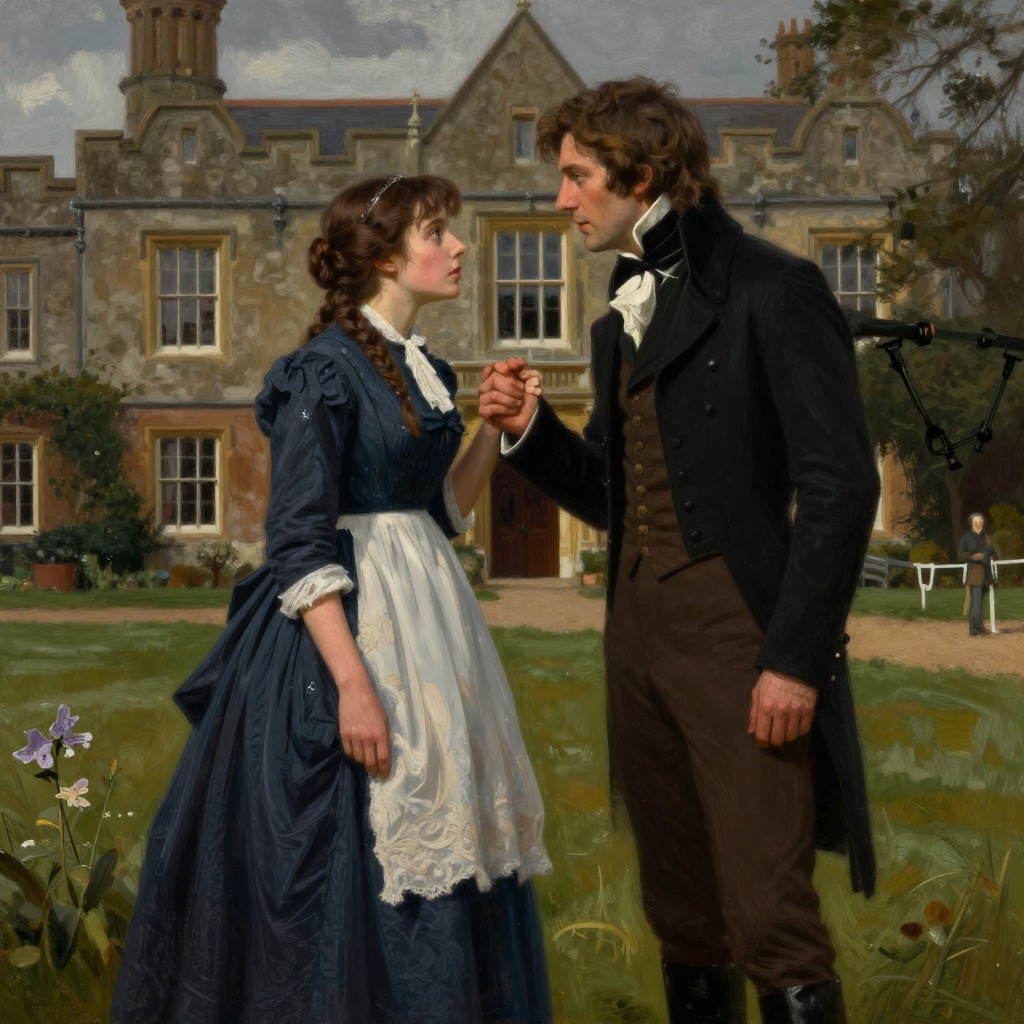
Mr. Rochester Proposes to Jane
On a beautiful midsummer evening, Mr. Rochester tells Jane that he must send her away to Ireland because he is to marry Miss Ingram. Jane, heartbroken, declares her love for him and her equality of soul. In response, Rochester reveals that his courtship of Miss Ingram was a ruse to make Jane jealous. He passionately proposes to Jane, asking her to be his wife. Overwhelmed with joy and disbelief, Jane accepts. This is the emotional climax of their relationship, a declaration of love that transcends social barriers.
the morning of the planned wedding at Thornfield
Jane's Wedding Morning
Jane prepares for her wedding, feeling both joy and a strange sense of foreboding. She and Mr. Rochester go to the church. Just as the ceremony is about to begin, a stranger, Mr. Briggs, steps forward and announces an impediment: Mr. Rochester is already married. He produces a witness, Richard Mason, who confirms that Rochester's wife, Bertha Mason, is still alive and living at Thornfield. The wedding is broken off. This event shatters Jane's hopes and reveals the terrible secret of Thornfield.
immediately after the interrupted wedding at Thornfield
The Madwoman Revealed
Mr. Rochester, enraged and desperate, leads the wedding party to the third storey of Thornfield. He unlocks a hidden room and reveals his wife, Bertha Mason, a violent, insane woman cared for by Grace Poole. Rochester explains the history of his disastrous marriage, arranged by his father for money. He describes Bertha's madness and his years of suffering. He pleads with Jane to understand his position and to stay with him, even as his mistress. This revelation explains all the mysteries of Thornfield and places Jane in an impossible moral dilemma.
the night after the interrupted wedding at Thornfield
Jane Leaves Thornfield
Despite Mr. Rochester's passionate pleas to stay, Jane resolves to leave Thornfield to preserve her moral integrity. She struggles with her love for him and her conscience. After a sleepless night, she steals away from the house at dawn, taking only a small bundle of belongings. She leaves a note for Mrs. Fairfax and Adele. She walks away from Thornfield, heartbroken but resolute. This event is the ultimate test of Jane's principles, choosing self-respect over love and security.
the days following her departure from Thornfield
Jane's Wandering and Starvation
Jane wanders destitute across the moors, having accidentally left her small parcel of belongings on the coach. She has no money and no friends. She tries to find work or food but is repeatedly turned away. She spends two nights sleeping in the open, suffering from hunger and cold. She nearly starves to death. This period of extreme hardship tests her physical and mental endurance to the limit and represents the lowest point in her life.
a few days after leaving Thornfield, at Marsh End
Jane is Taken in by the Rivers Family
Desperate and near death, Jane stumbles upon a house called Marsh End. She is initially turned away by the servant, Hannah, but is rescued by St. John Rivers, who brings her inside. He and his sisters, Diana and Mary, take her in, give her food and shelter, and nurse her back to health. Jane, using the alias Jane Elliott, slowly recovers. This event marks the beginning of a new life for Jane, providing her with a family and a sense of belonging.
a few weeks later, in Morton
Jane Becomes a Village Schoolmistress
After recovering, Jane accepts St. John's offer to become the mistress of a village school in Morton. She moves into a small cottage and begins teaching the poor girls of the parish. She finds the work challenging but rewarding. She also meets the beautiful and wealthy Rosamond Oliver, who takes an interest in her. This new life gives Jane independence and purpose, but she still secretly longs for news of Mr. Rochester.
a few months later, in winter at Marsh End
Jane Discovers Her Inheritance and Cousins
St. John Rivers reveals that he has discovered Jane's true identity. He tells her that her uncle, John Eyre, has died and left her a fortune of twenty thousand pounds. He also reveals that he, Diana, and Mary are her cousins, as their mother was her father's sister. Overjoyed, Jane insists on sharing her inheritance equally with them. This discovery transforms Jane's life, giving her wealth, family, and a new sense of identity and belonging.
a few months later, in spring at Marsh End
St. John Proposes to Jane
St. John, preparing to become a missionary in India, asks Jane to marry him and accompany him as his fellow-labourer. He admits he does not love her but believes she is suited for the work. Jane refuses, knowing she does not love him and that such a marriage would be a form of living death. St. John pressures her, appealing to her sense of duty and religion. Jane struggles with the decision, feeling the weight of his moral authority.
one night, just before St. John's departure for Cambridge
Jane Hears Rochester's Mysterious Call
As Jane is on the verge of agreeing to marry St. John, she hears a supernatural voice calling her name: 'Jane! Jane! Jane!' It is the voice of Mr. Rochester, filled with pain and urgency. She answers, 'I am coming!' The voice seems to come from nowhere and everywhere. This mystical experience convinces Jane that she must return to Rochester. She interprets it as a sign from God, overriding St. John's claims on her. This event is the turning point that leads to the novel's resolution.
the next day, journeying to Thornfield
Jane Returns to Thornfield
Jane leaves Marsh End and travels to Thornfield, determined to find Mr. Rochester. She arrives to find the house a blackened ruin. She learns from the innkeeper that Bertha Mason set the house on fire and died in the blaze. Mr. Rochester, in a heroic attempt to save her, was severely injured: he lost his sight and one hand. He is now living at Ferndean Manor. This news fills Jane with both horror and a renewed sense of purpose.
the same evening, at Ferndean Manor
Jane Reunites with Rochester at Ferndean
Jane travels to Ferndean Manor and finds Mr. Rochester, now blind and crippled, living in seclusion. She reveals herself to him, and their reunion is deeply emotional. Rochester, at first unable to believe she is real, is overwhelmed with joy. Jane tells him she is now an independent woman with a fortune. She declares her love for him and her desire to be with him forever. This reunion is the culmination of their love story, a triumph of the spirit over adversity.
a short time later, at a quiet ceremony
Jane Marries Mr. Rochester
Jane and Mr. Rochester are married in a simple, private ceremony. Only the parson and clerk are present. Jane writes to her cousins, Diana and Mary, who approve of the match. She also brings Adele to live with them, placing her in a better school. The marriage is one of perfect spiritual and intellectual equality. Jane becomes Rochester's eyes and hands, and they find complete happiness together. This event provides the novel's happy ending, fulfilling Jane's quest for love and independence.
two years after the marriage, at Ferndean
Rochester Partially Recovers His Sight
After two years of marriage, Mr. Rochester begins to regain the sight in one eye. He and Jane travel to London to consult an oculist, and his vision partially returns. He is able to see his first-born son, who has inherited his own large, black eyes. This recovery is a final blessing, symbolizing the redemption and healing that love has brought to both of them. The novel concludes with a brief account of the fates of the other characters, including St. John Rivers, who dies a missionary in India.